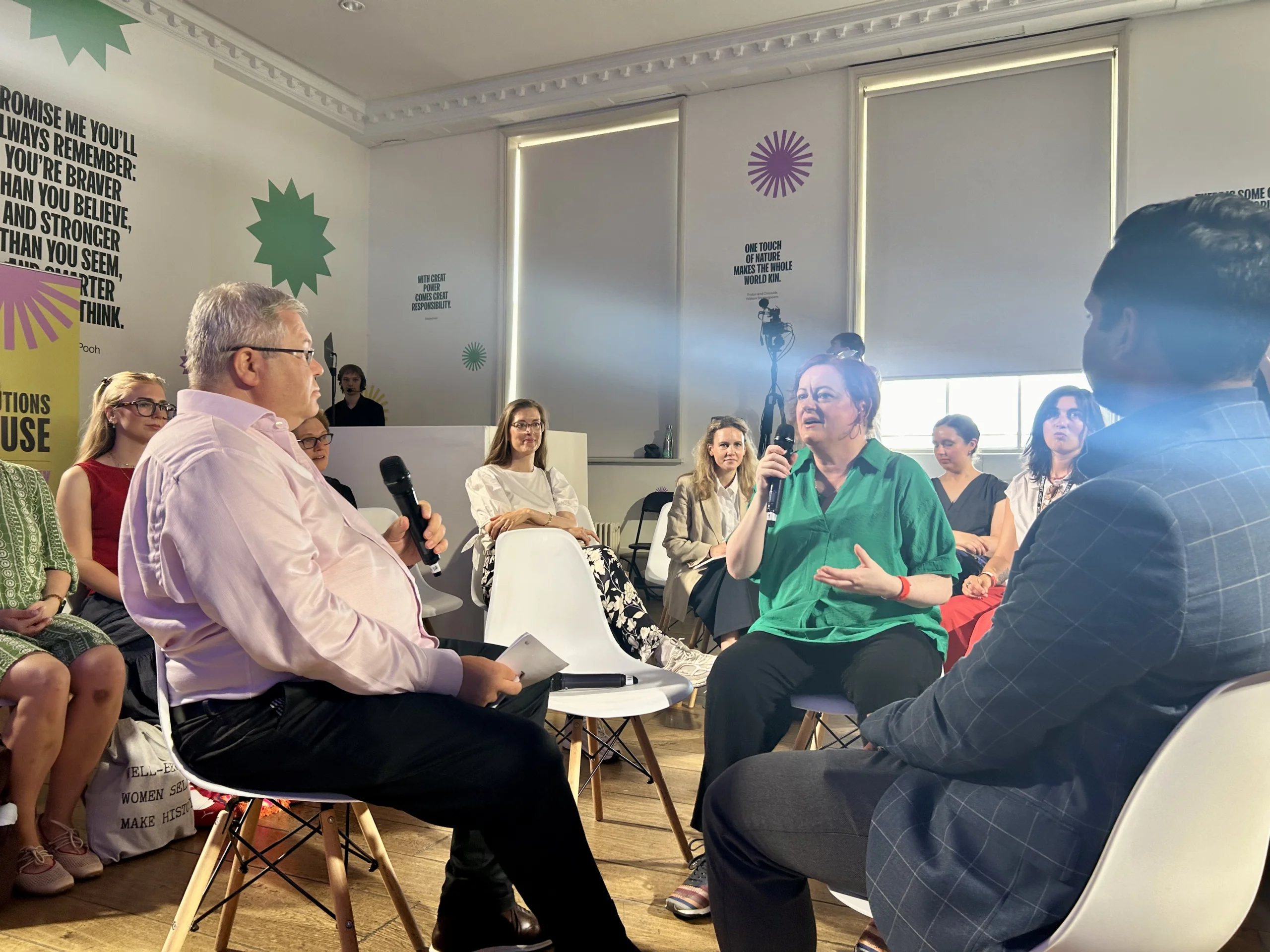
Sustainability is having a tough time at the moment. We brought together four leading lights at the intersection of business and sustainability to discuss and debate the business case for continued investment in this space.
What emerged was so much more: a shared imperative to reframe the whole sustainability narrative around a human story of security. Read on for some deeply insightful views that you’ll want to share with your organisation.
“What a brilliant session! I just watched the recording back this morning and am feeling very inspired. Fantastic speakers and very interesting themes.”
Emily Palmer, ESG Governance and Net Zero Manager, Boots UK
You can watch the recording here or read our digest and commentary below 👇
Global conflict, disruption and uncertainty are colliding with the rise of populist politics across the globe leaving many businesses feeling they need to reprioritise sustainability efforts either to focus on margin and survival or to stay in step with the perceived zeitgeist.
We see this every day in the world of sustainability consulting: net zero commitments have been ditched or watered down, budgets have been hacked and in-house teams feel uncertain about their future. As never before, our clients have been asking the question: “Is all this effort worth it? Who’s paying? What’s the ROI?”
Against this context, I wanted to spark a discussion about whether we’re looking at sustainability in the right way. Is it a nice-to-have cost that businesses can’t afford to bear in these times? Or is it actually a huge value driver that is short-sighted to ignore? What if reprioritising sustainability isn’t about choosing between profit and purpose, or between survival and zeitgeist? What if it’s about finding a path where these elements not only coexist but actively strengthen one another?
Big questions. So I brought together a group of leading lights at the intersection of business and sustainability for an online panel discussion. I deliberately chose guests who would put the cat amongst the pigeons and look at the question in a genuinely enquiring way. The goal was not to start in violent agreement, even if we ended up there.
The brief was also not to debate the science or the necessity of acting on the climate and biodiversity crises; that was taken as read. Our job was to discuss the business framing: the risks and opportunities of embracing or de-prioritising sustainability within business models.
The business case for sustainability: cost or competitive edge?
This was the question I posed.
As I should have expected from a group of such brilliant people, they shot down the question in no time.
“The question is irrelevant,” fired off Joanna Allen, CEO of frozen snacking brand Little Moons. “What matters is that we’re building better businesses that are not just limited to profit. And we need to define ‘better’ based on all the needs of all stakeholders. We live in an ecosystem – what is good for one is good for others.”
Riffing off Joanna, Amy Clarke – co-founder and Chief Impact Officer of Tribe Impact Capital as well as trustee of B Lab UK and global board member at Client Earth – challenged whether we should be talking about sustainability, or about security and resilience.
How reframing sustainability as business security protects value
It was a great point: framing is critical to winning any debate, and the panel acknowledged that the climate movement and promoters of sustainability have done a lousy job of winning critics over in the past five decades.
Compare a narrative built on complex acronyms, “do less bad” or “own and fly less” with mantras like (trigger warning) “Make America Great Again” or “Take Back Control” and it’s easy to see why. People don’t respond well to being told what to do or being asked to understand complex issues, then find their own solutions. They want short, snappy answers to the things that matter to them.
The fossil fuel industry, aside from literally owning the economy and many media outlets, has the simplest narrative of all: “You need oil. We sell it. It’s cheap.”
It’s easy to see why sustainability has failed to win the hearts and minds in quite the same way.
But the reality for business is that sustainability does matter, and will matter more and more with each passing wildfire, drought or supply chain disruption. As Chris Norman MBE, founder and CEO of the Good Agency, put it: “This is not just about value creation but value protection. Every business will have to become sustainable because of simple economics: the scarcity of supply of the things they sell. You can’t get a strategy in place unless you have alignment between the commercial imperative and a compelling story.”
Jamie Butterworth, founding partner at Circularity Capital and former founding CEO of the Ellen MacArthur Foundation, agreed: “Companies using circular business models to drive long-term competitive advantage will outperform.” And, as he said to me afterwards, that was coming from the most hardcore capitalist in the room.
Thinking back to my own journey into sustainability, it was in fact Jamie who, in 2011, lit my fire. Explaining the circular economy in very simple terms, and without using words like ‘eco’, ‘sustainable’ or ‘green’, he told me simply that the economy is built on the cheap availability of finite resources like oil and rare earth metals. When they are gone or become uncommercial to extract, we have nothing to sell. What then?
Infinite growth on a finite planet simply isn’t possible, as economists as far back as the 1970s have recognised; this is the real issue businesses need to be discussing. As Amy put it: “How do we bridge the framing between where we are and what feels obvious: the ‘system’ is fragile. We need to make it anti-fragile.”
Storytelling, not reporting: how ESG narratives drive stakeholder buy-in
The panel agreed that asking a question like mine, which implies there’s a trade-off between profit and impact, is deeply unhelpful. What we have is a human problem to which we’ve failed to find (and sell) the motivation to engage.
So, what is the story we should tell to motivate people to engage? Can we have a single message, like the populists? Or do we need a single core message that can be adapted to multiple audiences and speak to the various different ways in which people need to engage?
Ultimately, it comes down to storytelling.
We can’t motivate leaders through data or regulation. We need to challenge the transactional nature of how sustainability is being viewed. We need to challenge our very relationship with profit and short-termism if we’re to have secure business models and societies into the future.
Why every CEO needs to rethink sustainability as strategy
Synthesising this discussion was a very cathartic experience for someone who has been trying for years to ‘sell’ sustainability in ever more challenging times. At Greenheart we’re already using tailored frameworks and resilience tools to help clients reframe sustainability around security. But there is so much more we can do to engage companies with it:
- This is more fundamental than ‘sustainability’ – it’s about security.
- We need to reframe everything and stop trying to sell complex solutions to complex challenges. Instead, let’s have one simple story and adapt it as necessary. It doesn’t have to be a story of moral indignance, nor one based on risk. But a human story that leaves people asking: “What’s not to like?”
- Getting traction for that story will require deep empathy: we need an army of ‘investor whisperers’, actors and communicators to make sure we’re all really listening to the challenges people have with that story.
- People need to be told this is one of the most exciting opportunities of our time.
- B Corp is part of the story because it shows that ‘better’ can exist within a “predatory system”.
As we brought the session to a close, I realised that my planned final question wouldn’t work. I wanted to ask, in one sentence: “Why keep (or kill) sustainability in your business strategy?” Instead, I asked my panel what was the one thing they’d like every CEO to do tomorrow. Here’s what they said:
Jamie: “To see the opportunity that it represents in its fullest form. There are a growing number of leaders of businesses who…see the opportunity it represents for their business, their employees and the broader community.”
Joanna: “Be curious enough to stand in the shoes of the person who doesn’t agree with you and don’t assume better business comes at the expense of profit.”
Chris: “Understand the business opportunity, but that this is a human challenge. Tell a better story and give people a role in that story – a role that is commensurate with their ability, their capacity, their ambitions and their desires – not just broadcasting to them.”
Amy: “Knowing everything we now know about the environmental, cultural, social, political and economic crises, are you happy? If not, why not and do something about it?”
If you do nothing else in the 10 minutes after you read this, please go for a walk and reflect on Amy’s question. Then let us know what you think…

Stay Updated and Get Support
If you want to reframe sustainability within your business, book a no-obligation call with one of our strategic advisors here.
Or you can:
- Sign up to our newsletter to get regular insights straight to your inbox
- Check out our website to see how we help companies across sectors – from CPG to financial services – use B Corp, materiality assessment, life cycle assessment and other tools to reframe sustainability.
“[This discussion] has inspired me to work harder not only on our product sustainability but also on our communication story. We have to try and do more!!”
Lisa Gaynor, Head of Product & Sustainability, Red Cactus
In memory of Andrew Kassoy, co-founder of the B Corp movement, who died last month.
The final conversation between him and his B Lab and Sistema B colleagues, referred to in the panel discussion, can be found here.